Generate digital North Carolina Architect stamps instantly
- STATE BOARD APPROVED
- HIGH-QUALITY FILES IN VARIOUS FORMATS
- INSTANT ACCESS
- FREE-OF-CHARGE REVISIONS
Your board-compliant seal will be ready for download after purchase
Board approved
Your North Carolina Architect seal from pedigitalstamps.com meets every requirement on this page — the required wording, the layout and the diameter set out in 21 NCAC 02 .0206 (Requirement for and Use of Professional Seal by an Architect or Registered Interior Designer); N.C. Gen. Stat. § 83A-10(a). Fill in your details and download it in seconds.
The seal design rule for engineers and land surveyors is 21 NCAC 56 .1102; .1103 governs how the seal is used, and summaries that cite .1103 for the seal's appearance are citing the wrong rule. 21 NCAC 56 .0104 describes the Board's own official seal — the Great Seal of the State with the Board name on the perimeter — and is not the licensee's seal. The Code and the statutes name the engineering and surveying board the "North Carolina State Board of Examiners for Engineers and Surveyors" (21 NCAC 56 .0101; G.S. 47-30(d)), while the Board itself uses the shorter "North Carolina Board of Examiners for Engineers and Surveyors" on its own site; the Code form is used here. The architect rule, 21 NCAC 02 .0206, was readopted effective June 1, 2026 and is the current text; the readoption added language to Paragraph (d) permitting unlocked copies of sealed construction documents to be provided for plan review approval stamps or contractor material takeoffs where document content is not effectively being altered. North Carolina also registers interior designers through the architecture board under the same rule, but their seal is two concentric ovals two inches tall by 2.75 inches wide bearing "Registered Interior Designer" (21 NCAC 02 .0206(a)(5)(B)) — a different credential from an architect and not a circular seal. The North Carolina Administrative Code is published by the Office of Administrative Hearings on a server that answers over HTTP only, which is why the rule links here are http:// rather than https://.
Full North Carolina Architect seal requirements, with every citation →
File formats
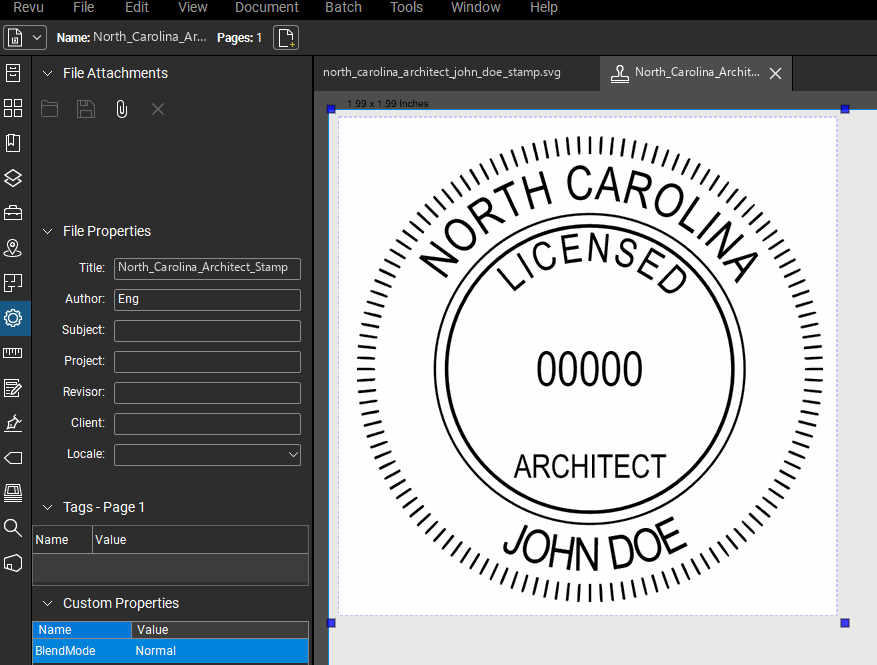
HIGH-QUALITY RASTER FORMAT
VECTOR FORMAT, INFINITELY SCALABLE
UNIVERSAL DOCUMENT FORMAT
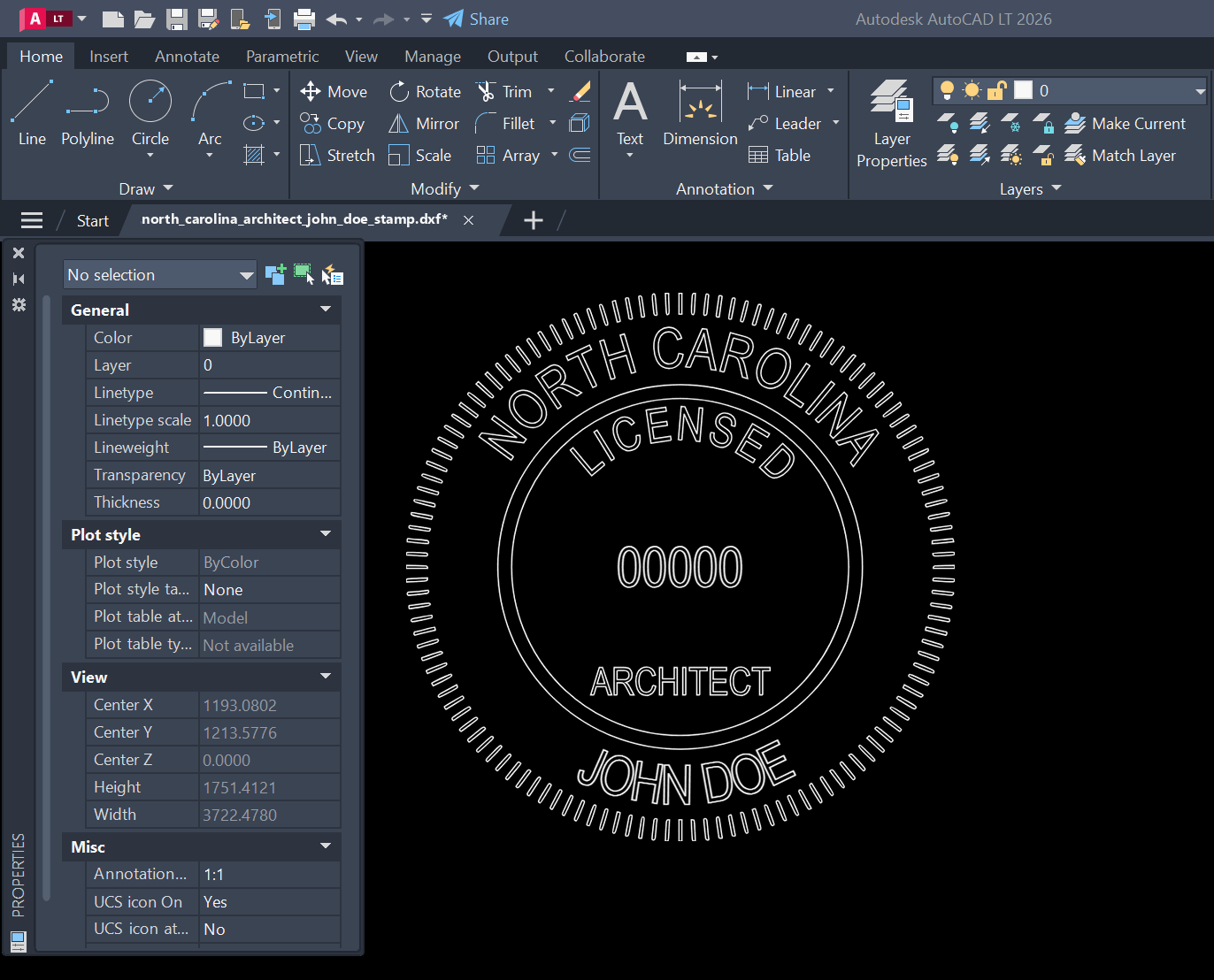
AUTOCAD COMPATIBLE FORMAT
PROFESSIONAL PRINT FORMAT
How it works
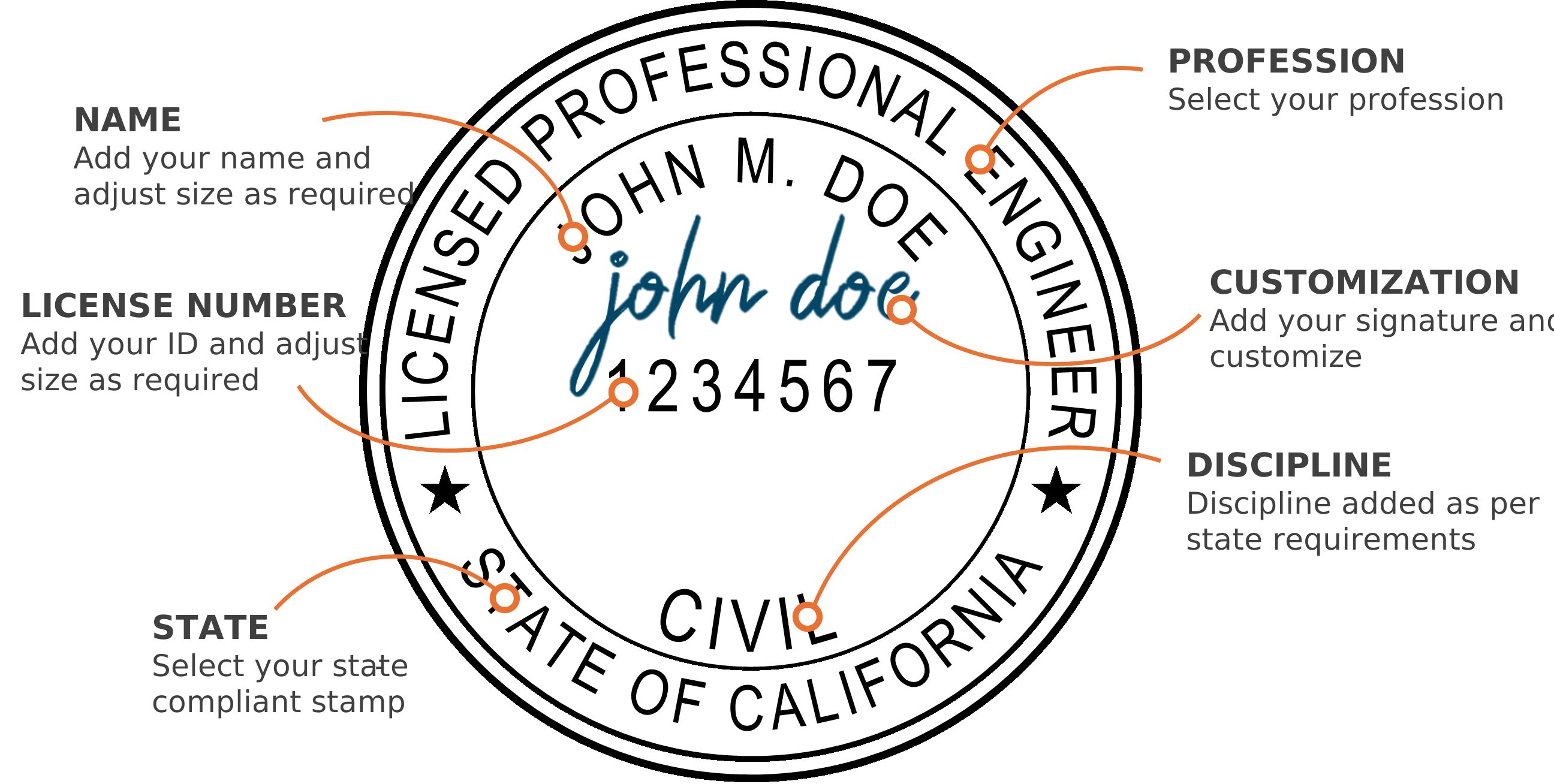
Select your state & profession
Add your name & license number
Adjust the text size using the controls
Select your discipline
Add your signature & customize (optional)
Download instantly to your computer
Software compatibility


Who we are
Our digital North Carolina Architect stamp generator creates instant state-approved electronic architect stamps. Our platform provides full customization of your digital seal, including an option to add your signature. Professional Engineer (PE) stamps, Architect stamps, and Land Surveyor stamps are available for immediate download after customization. There is no waiting. Every electronic professional seal we generate is 100% compliant with state board requirements, ensuring your digital stamp meets all necessary standards.
State boards


FAQ
Frequently asked questions about North Carolina digital architect stamps and seals.
Once you are licensed in North Carolina, you can generate your seal here and download it immediately. Fill in the form and position your signature if you want one. The layout follows 21 NCAC 02 .0206 (Requirement for and Use of Professional Seal by an Architect or Registered Interior Designer); N.C. Gen. Stat. § 83A-10(a), which is the provision the North Carolina Board of Architecture and Registered Interior Designers will measure the seal against.
North Carolina’s architect stamp rule is 21 NCAC 02 .0206 (Requirement for and Use of Professional Seal by an Architect or Registered Interior Designer); N.C. Gen. Stat. § 83A-10(a), administered by the North Carolina Board of Architecture and Registered Interior Designers, a different body from the engineering board. The seal must carry “Licensed Architect”, and two concentric circles, 1½ to 1¾ inches in diameter. The firm seal is the same size.
A further 9 requirements, each tied to the subsection that imposes it, are itemised in the North Carolina requirements section on this page.
Two concentric circles, 1½ to 1¾ inches in diameter. The firm seal is the same size. This is set by 21 NCAC 02 .0206(a)(3)(B).
The architect legend is "Licensed Architect". "Registered Architect" is not a North Carolina credential — "Registered Interior Designer" is the separate registration issued by the same board, on an oval seal. (21 NCAC 02 .0206(a)(3)(B), (a)(5)(B))
Yes. 21 NCAC 02 .0206(a) opens by providing that an architect shall seal his or her work whether or not the work is for an exempt project as defined in G.S. 83A-13. The rule does not carve exempt projects out of the sealing requirement; it names them and requires the seal anyway. The same sentence adds the limit that does apply — an architect shall not sign or seal drawings, specifications, reports or other professional work that was not prepared by the architect or under his or her responsible control. (21 NCAC 02 .0206(a); N.C. Gen. Stat. § 83A-13)
Across its face, not beside it. 21 NCAC 02 .0206(a)(3)(C) makes the original, handwritten signature of the individual named on the seal part of the individual seal, and requires it to appear across the face of each original seal imprint along with the date of affixation; (a)(11) puts it plainly, that the architect must personally sign over the imprint of the seal. Signature reproductions — rubber stamps, computer generated, or other facsimiles — are not permitted on paper copies in lieu of actual handwritten and hand dated signatures. The engineering board's rule is looser on placement: there the written signature may be placed over, or adjacent to, the seal. (21 NCAC 02 .0206(a)(3)(C) and (a)(11); cf. 21 NCAC 56 .1103(a)(3))
It depends on how the firm is organized, and it never replaces the individual seal. 21 NCAC 02 .0206(a)(4)(B) puts the firm's approved name between the two circles and the firm license number in the innermost circle, at the same 1½ to 1¾ inch size as the individual seal, and then adds words along the inside perimeter of the inner circle that differ by entity type: "Architectural Corporation, North Carolina" for a professional corporation, and "Architectural Company" for a professional limited liability company. The firm seal must be affixed on the cover sheet in addition to the individual seal, and the firm must designate a principal or other authorized individual to be responsible for its security. (21 NCAC 02 .0206(a)(4)(B) and (a)(12); N.C. Gen. Stat. § 83A-10(a))
Four kinds, and two of them carry wording the rule dictates. Presentation documents such as renderings used to communicate conceptual information shall not be sealed or signed. Sheets or pages prepared by licensed professional consultants, such as structural, mechanical or electrical engineers, bear that consultant's own seal and license number and shall not be sealed by the architect. Incomplete documents may be released for interim review without the seal or signature, but must be dated, bear the architect's name and be marked "Incomplete - for interim review only and not intended for bidding, procurement, permit, or construction purposes." Post-construction record drawings shall not be sealed and must state that "these drawings are post construction record drawings and are based in part upon the representations of others and are not for bidding, procurement, permit, or construction purposes." (21 NCAC 02 .0206(a)(8), (a)(9), (a)(10) and (c))

Yes, on conditions, and the first architect's seal stays on the sheets rather than coming off. 21 NCAC 02 .0206(b) lets prototypical building design documents prepared by an architect licensed in this State or in the state of origin be sealed by a succeeding North Carolina architect provided the original architect's seal appears on the documents to authenticate authorship; the words "Prototypical Design Documents/Not for Construction" appear on each sheet by the original architect; the successor identifies all modifications and assumes responsibility for the adequacy of the design for the specific application in North Carolina; and the successor's seal is accompanied by the statement "These documents have been examined by the undersigned. I have determined that they comply with existing local North Carolina codes, and I assume responsibility for the adequacy of the design for the specific application in North Carolina." (21 NCAC 02 .0206(b))